Project Voltaic: Investment Committee Memorandum
Acquisition of 100% of Ironvale Digital Infrastructure, LLC · Final bid recommendation · Buy-side deal team
3. Investment thesis
1. Energized capacity where power is the constraint. Vacancy in the major US colocation markets is below 2% and utility interconnection queues of 3 to 7 years gate new entry in every Ironvale market; the market study puts its US hyperscale demand index at 296 in 2025 (2020 = 100). Ironvale’s 220.0 MW is verified by the technical review.
2. Contracted growth already in construction. PHX II is 70% and ATL II 40% pre-leased to two of the three anchors (59% blended). We underwrite $99.0M of stabilized EBITDA from the 96 MW, a 9.8% yield on total cost, below the low-teens yield the CIM cites; it carries buyer EBITDA from $212.1M in FY26 to $335.2M in FY31.
3. Hard-asset value under the price. The reference multiple of 19.2x is the six campus appraisals ($4,095M as is at 31-Mar-26) over FY25 EBITDA before other income ($212.8M); it values the operating buildings only, with no platform premium and no development pipeline.
4. Optionality we do not pay for. The long-range plan reaches $540M of FY30 adjusted EBITDA on the land bank against $329.3M in our case. We treat it as an option: the plan costs new phases at about $6.8M per MW against $10.3M for capacity in flight and $11M to $14M in the market, a shortfall of about $0.8B of capital.
You are the associate on the buy side. Your indication of interest for Project Voltaic got you into Phase II of Kingsmill & Co.’s sale of Ironvale Digital Infrastructure, a US data center developer and operator with 220 MW of commissioned capacity in six markets. Since the CIM review, the team has retested the seller’s numbers in financial due diligence. Final bids are due, and nothing goes to Kingsmill until the investment committee approves the price.
Your job now is the investment committee memo: one document that tells the committee what it is buying, at what price, how it is paid for, what it earns and what still has to be true before signing. This page builds that memo one section at a time, each step run in Compound. The answer at the end is a recommended final bid that the committee can approve with nine open items attached.
An investment memo, or investment committee (IC) memo, is the deal team’s written case for a transaction, and the IC decides on it. In private equity it carries the recommendation and terms, a company overview, the investment thesis, the diligence findings, valuation, financing, returns, risks and the open items. A one-page IC summary slide puts the same decision in front of the committee at the meeting. Credit committees read a credit memo with the same discipline, built around leverage, covenants and the downside case.
Ironvale Digital Infrastructure and Project Voltaic are fictional: the company and its data room are the open data room of PE Bench, published under CC-BY-4.0. Everything Compound produced on this page is real: the IC memo, the summary slide and the returns workbook come from one Compound run on that room, quoted unedited apart from excerpts.
What goes in an investment committee memo
The first step sets the memo’s sections in the order a committee reads them, so the decision comes first and the support follows.
Compound’s memo runs to seven sections. Each one answers a question the committee will ask.
| Section | What it answers |
|---|---|
| 1. Recommendation and price | What we bid, on what terms, and the conditions for approval |
| 2. Company overview | What we are buying: campuses, capacity, tenants and the numbers that define it |
| 3. Investment thesis | Why we want to own it, in five points |
| 4. Key diligence findings | What the data room changed from the seller’s story, and how the price treats each finding |
| 5. Valuation and returns | How we got to the price, sources and uses, base-case returns and sensitivities |
| 6. Key risks and mitigants | What could go wrong, what limits it and what remains |
| 7. Open items before signing | What has to be settled between approval and signature |
Every figure in the memo carries its data room document number and page. Figures from the executed hyperscale leases, which sit in the clean team room, appear only in aggregate, with the three tenants named Tenant A, B and C.
Takeaway: a committee reads the recommendation first and the support after it, so the memo starts with the earnings base the price is built on.
The earnings base: $206.9M of buyer EBITDA, not $224.0M
The second step carries the diligence result into the memo as one bridge from the seller’s adjusted EBITDA to the buyer’s.
4. Key diligence findings
The earnings base is $206.9M, not the seller’s $224.0M. Add-back tests take $8.9M out (to $215.1M): pre-process transaction costs, the severance add-back (rejected; the roles are being rehired), VPPA settlements and interest income. The $5.8M of development and management fees stays in. A further $8.2M of power cost is absorbed rather than passed through.
- Reported EBITDA: 219.1 Audited FS FY25 (2.03) p4
- Adjusted EBITDA, seller definition: 224.0 seller, 220.5 buyer, after transaction costs cut to post-authorization spend and the severance add-back rejected
- (-) VPPA settlements and interest income: (5.4), with fees of 5.8 kept in Audited FS FY25 (2.03) p14
- After add-back tests: 215.1
- (-) Power cost not recovered from tenants: (8.2) Power interval data (6.04)
- Buyer adjusted EBITDA: 206.9; LTM Mar-26 217.9; cash basis 198.5
These are the buy-side figures from the financial due diligence example, so the memo, the diligence workbook and the lenders all start from the same $206.9M. The add-back tests are worked one by one on the adjusted EBITDA page. The memo keeps the $5.8M of development and management fees in EBITDA because they come under contracts, and it removes interest on cash because a cash-free, debt-free deal takes the cash away.
Takeaway: the memo prices $206.9M of FY25 EBITDA, $17.1M below the seller’s figure, so the next question is what that base is worth at the closing date.
The final bid: the IOI carried to the closing date
The third step sets the price, and the memo states it with the bridge from the IOI and the multiples it implies.
The IOI valued PHX II and ATL II, the two buildings under construction, at cost spent to March 31, 2026. By the December 31, 2026 close, the seller plans to spend another $366M on them, and the bid credits that spend dollar for dollar.
| B | C | |
|---|---|---|
| 35 | Item | Value |
| 36 | IOI enterprise value, CIM review ($M) | 4,225.0 |
| 37 | IOI range, low ($M) | 4,143.5 |
| 38 | IOI range, high ($M) | 4,298.7 |
| 39 | Plan spend on PHX II, Apr-Dec 2026 ($M) | 206.0 |
| 40 | Plan spend on ATL II, Apr-Dec 2026 ($M) | 160.0 |
| 41 | Recommended final bid at a 31-Dec-26 close ($M) | 4,591.01 |
| 46 | FY26 budget adjusted EBITDA, seller definition ($M) | 272.0 |
| 48 | EV at 18.0x FY26 budget, seller definition ($M) | 4,896.02 |
| 51 | FY26 budget adjusted EBITDA, buy-side definitions ($M) | 252.63 |
| 52 | EV at 18.0x FY26 budget, buy-side definitions ($M) | 4,546.4 |
| 53 | Recommended bid / FY26 budget EBITDA, seller definition | 16.9x |
| 54 | Recommended bid / FY26 budget EBITDA, buy-side definitions | 18.2x |
| 55 | Recommended bid / buyer FY25 adjusted EBITDA | 22.2x |
| 56 | Recommended bid / buyer LTM Mar-26 adjusted EBITDA | 21.1x |
| 58 | Appraised value, six operating campuses, as is 31-Mar-26 ($M) | 4,095.0 |
| 59 | FY25 EBITDA before other income (NOI less G&A) ($M) | 212.8 |
| 60 | Reference multiple: values the operating buildings only | 19.2x4 |
- 1The $4,225M IOI plus $366M of plan spend on PHX II and ATL II from April to December 2026, trued up to actual spend at closing
- 2The 18.0x test on the seller's budget: $305M above the bid, for a 7.9% gross IRR
- 3The seller's FY26 budget less other income other than the $5.8M of fees, and less $8.2M of unrecovered power, both held at FY25 levels
- 4Six campus appraisals over FY25 EBITDA before other income. It values the operating buildings only, with no platform premium and no development pipeline
1. Recommendation and price
We recommend that the Committee approve a final bid of $4,591M of enterprise value for 100% of the equity of Ironvale Digital Infrastructure, LLC at a 31-Dec-26 close, cash-free and debt-free with normalized working capital. The bid starts from our $4,225M IOI (range $4,144M to $4,299M), which valued capacity in flight at cost to 31-Mar-26, and adds the $366M the seller is planned to spend on PHX II and ATL II from April to December 2026, credited dollar for dollar. It is the same value as the IOI, moved to the closing date.
Price discipline. FY26 budget adjusted EBITDA is $272.0M on the seller’s definitions (NOI $293.0M less G&A $38.0M plus $17.0M of other income). At 18.0x that would cost $4,896M, $305M above our bid, for a 7.9% gross IRR. Restated on buy-side definitions (other income other than development and management fees removed, and unrecovered power deducted) the FY26 budget is $252.6M, and 18.0x is $4,546M. The recommended $4,591M is 18.2x the budget on buy-side definitions.
Price. $4,591M of enterprise value: the $4,225M IOI plus a dollar-for-dollar credit for seller spend on capacity in flight after 31-Mar-26 ($366M on plan), trued up to actual spend at closing.
The bid is $4,591M, 22.2x buyer FY25 EBITDA and 18.2x the FY26 budget restated on buy-side definitions. The 19.2x reference multiple is a floor for the buildings, not a price for the company: it divides the six campus appraisals by EBITDA before other income, so it gives nothing for the platform or the development pipeline. Add the $874M that PHX II and ATL II will have cost by the close, and the assets are worth about $4,969M. The bid sits 7.6% below that, before any value for the roughly 400 MW land bank.
The memo also tests the bid against a round 18.0x of FY26 budget EBITDA. On the seller’s definitions that would cost $4,896M, $305M more, and cut the base-case return to 7.9%. On buy-side definitions it is $4,546M, close to the bid. Paying 18.0x the seller’s budget would mean paying for other income and power cost that diligence took out.
Compound put the decision on one slide for the committee meeting.
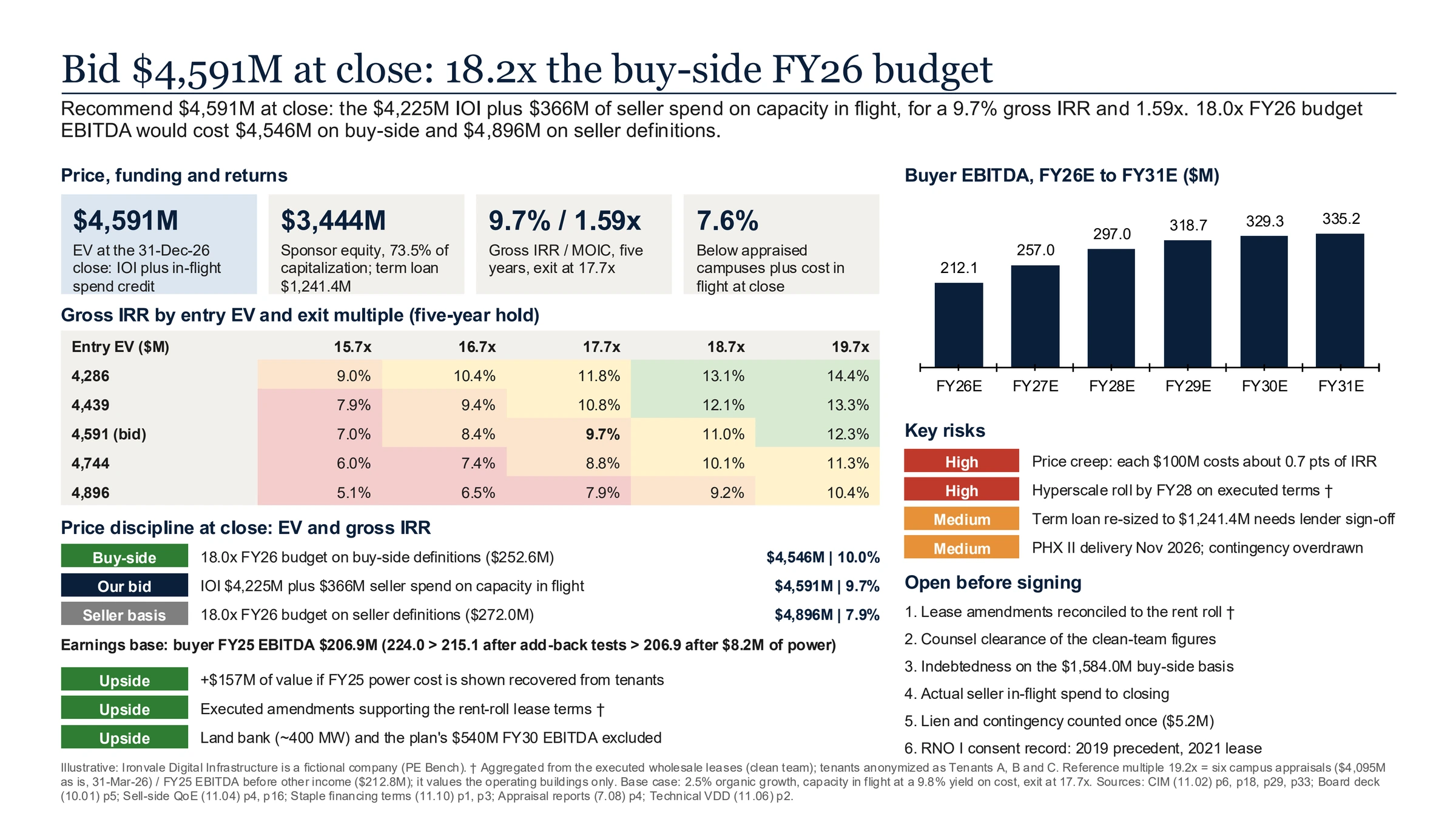
Takeaway: the recommended final bid is $4,591M at the December 31, 2026 close, the IOI’s value moved to the closing date, and the next step is how it is paid for.
Sources and uses on $1,584.0M of net debt
The fourth step funds the bid on the buyer’s net debt and a staple loan re-sized to the buyer’s EBITDA.
| B | C | D | |
|---|---|---|---|
| 89 | Item | $M | % of total |
| 90 | Equity purchase price to sellers (EV less net debt and debt-like items) | 3,007.0 | 64.2% |
| 91 | Repayment of net debt and debt-like items | 1,584.01 | 33.8% |
| 92 | Development reserve, equity-funded (cost to complete above DDTL) | - | 0.0% |
| 93 | Arrangement fees | 36.2 | 0.8% |
| 94 | Term loan OID | 12.4 | 0.3% |
| 95 | Buyer transaction costs | 45.9 | 1.0% |
| 96 | Total uses ($M) | 4,685.5 | 100.0% |
| 97 | Term loan (re-sized) | 1,241.42 | 26.5% |
| 98 | Sponsor equity invested, excl. rollover | 3,444.1 | 73.5% |
| 99 | Total sources ($M) | 4,685.5 | 100.0% |
| 100 | Sponsor equity share of capitalization vs 40% minimum | 73.5%3 | 40.0% |
| 101 | Term loan / buyer adjusted EBITDA FY25 | 6.0x | |
| 102 | Term loan / buyer adjusted EBITDA LTM Mar-26 | 5.7x |
- 1Buy-side net debt and debt-like items at December 31, 2025. The seller's QoE says $1,506.9M
- 26.0x buyer FY25 EBITDA of $206.9M. The staple offers $1,344M, 6.0x the seller's $224.0M, so the smaller loan needs lender sign-off
- 3Well above the staple's 40% minimum cash equity
The staple was sized at 6.0x the seller’s $224.0M, $1,344M. Compound re-sizes it to 6.0x the buyer’s $206.9M, $1,241.4M, which is 5.7x LTM March 2026 EBITDA. The $250M delayed-draw term loan funds the $131.6M the buyer still has to spend on PHX II and ATL II after closing, and the $150M revolver stays undrawn. Net debt follows the diligence: $1,584.0M on the buy-side definition, $77.1M more than the seller’s $1,506.9M, and every dollar of it comes off the equity paid to the sellers.
Takeaway: the buyer’s net debt and a $1,241.4M term loan leave sponsor equity at 73.5% of capitalization, so the returns rest on the equity cheque.
Returns: what the base case earns over five years
The fifth step runs the base case to a 2031 exit and shows where the return comes from.
The base case grows the operating campuses at 2.5% a year, ramps PHX II and ATL II to $99.0M of EBITDA by FY30, a 9.8% yield on cost, and sweeps excess cash to the term loan. It exits at 17.7x, the low-case buyer multiple from the IOI, with no value for the long-range plan.
| B | C | D | E | F | G | H | |
|---|---|---|---|---|---|---|---|
| 107 | Fiscal year ending | FY26E | FY27E | FY28E | FY29E | FY30E | FY31E |
| 112 | Buyer EBITDA ($M) | 212.1 | 257.0 | 297.0 | 318.7 | 329.3 | 335.2 |
| 134 | Net debt ($M) | 1,241.4 | 1,261.6 | 1,084.8 | 875.5 | 642.4 | 388.2 |
| 135 | Net debt / buyer EBITDA | 5.9x | 4.9x | 3.7x | 2.7x | 2.0x | 1.2x |
| 142 | Sponsor equity value at exit ($M) | 3,241.1 | 4,120.0 | 4,708.5 | 5,128.4 | 5,485.1 | |
| 143 | MOIC if exited this year | 0.94x | 1.20x | 1.37x | 1.49x | 1.59x | |
| 144 | IRR if exited this year | (5.9%) | 9.4% | 11.0%1 | 10.5% | 9.7%2 |
- 1Returns peak on an FY29 exit, once PHX II and ATL II are nearly stabilized
- 2Base case: five-year hold, exit at 17.7x FY31 EBITDA with 1% exit costs
The base case makes 9.7% gross IRR and 1.59x. EBITDA growth, most of it from the buildings under construction, adds $2,270.5M of equity value at the exit multiple, and paying down debt adds $853.2M. Exiting at 17.7x, below the multiple the bid pays on FY25 EBITDA, costs $928.9M. That is a modest return for a private equity fund, and the memo says so. It argues for the deal on the asset value under the price and the upside it does not pay for: lease amendments, documented power recovery and a higher exit multiple. The private equity returns and LBO model pages take the same mechanics further.
Takeaway: the base case earns 9.7% and 1.59x, with multiple compression its largest drag, so the committee will want to see how far price and exit multiple move it.
IRR sensitivity: entry price against exit multiple
The sixth step tests the return against the two numbers the committee argues about most, what we pay and what we sell for.
| C | D | E | F | G | H | |
|---|---|---|---|---|---|---|
| 161 | 9.7% | 15.7x | 16.7x | 17.7x | 18.7x | 19.7x |
| 162 | 4,286 | 9.0% | 10.4% | 11.8% | 13.1% | 14.4% |
| 163 | 4,439 | 7.9% | 9.4% | 10.8% | 12.1% | 13.3% |
| 164 | 4,591 | 7.0% | 8.4% | 9.7%1 | 11.0% | 12.3% |
| 165 | 4,744 | 6.0% | 7.4% | 8.8% | 10.1% | 11.3% |
| 166 | 4,896 | 5.1% | 6.5% | 7.9% | 9.2% | 10.4% |
- 1Base case: the recommended bid and a 17.7x exit
Each $100M of price moves the IRR by about 0.7 points, and each turn of exit multiple by about 1.3 points. Two turns of exit multiple are worth about as much to the return as $400M of price. The sensitivity analysis page shows how to set up a grid like this as a live Excel data table.
Takeaway: at the recommended bid the IRR runs from 7.0% at a 15.7x exit to 12.3% at 19.7x, so the memo’s last word is what could push it down and what must be settled first.
Risks and open items before signing
The last step turns what diligence left open into the conditions of the committee’s approval.
7. Open items before signing
- Every executed amendment and phase supplement for the three wholesale leases, reconciled to the rent roll expiries †. Up to about $233M of value; executed agreements control over the rent roll.
- Count the PHX II lien and overdrawn contingency once: they sit both in the $17.6M EV deduction and in the $1,584.0M debt-like items. $5.2M of double count in the price.
- Lender sign-off on a term loan of $1,241.4M (6.0x $206.9M), with flex terms, committed at signing. Final bids must be fully financed.
- FY25 utility invoices and tenant power billing reconciled to the P&L. Settles the $8.2M a year of unrecovered power.
Hyperscale lease term
Up to $233M
Counted twice
$5.2M
Staple re-sized
$1,241.4M
Power recovery
$8.2M a year
The double count is the finding nobody would make from one workbook. The $17.6M deducted from value for PHX II and the $1,584.0M of debt-like items were built in different steps, and both include the lien claim and the overdrawn contingency. The memo’s risk table rates the hyperscale roll by FY28 high and concentration, development execution, financing and rates medium, each with its mitigant.
Takeaway: the committee can approve the bid on nine conditions, and the lease amendments and the staple re-sizing are the two that decide whether it stands.
IC memo template (Word)Compound’s investment committee memorandum for Project Voltaic, free and without a form: recommendation and proposed terms, company overview, thesis, diligence findings, valuation, sources and uses, returns and sensitivities, risks and the nine open items, every figure cited to its data room document and page. Use it as an investment memo template: keep the section order and replace the deal.Download · Free, no form Returns case workbook (Excel)The workbook behind the memo: entry and financing inputs, the price block, operating and exit inputs, sources and uses, the five-year projection with the debt schedule, returns by exit year, price scenarios and the IRR and MOIC data tables, formulas intact.Download · Free, no form IC summary slide (PowerPoint)Compound’s one-page summary of the memo for the committee meeting: price, funding and returns, the IRR grid, the earnings base, upsides, risks and open items.Download · Free, no form