| C | D | E | J | |
|---|---|---|---|---|
| 5 | Filing | Change | What changed | Source |
| 13 | FY2024 | Removed | Controlled company risk removed; sponsor risk softened from "significant influence" with "control" to "influence" | 10-K FY2023, p. v; 10-K FY2024, p. v |
| 17 | FY2025 | Added | Four merger risks lead the summary (deal may not close, merger lawsuits, limits on alternatives, interim covenants); new Merger Risks section opens Item 1A | 10-K FY2025, p. iv; 10-K FY2025, p. 16 |
| 25 | FY2025 | Reworded | Q4 ARR up 77% to $841.0m; acquired entities contributed $282.0m | 10-K FY2025, p. 471 |
| 44 | FY2023 | Added | Material weakness in IT general controls over the invoicing systems; disclosure controls not effective at 31 Dec 2023 | 10-K FY2023, p. 99; 10-K FY2023, p. 100 |
| 46 | FY2025 | Added | ICFR assessment excludes Enfusion and Beacon: about 23% of assets (ex goodwill) and 27% of revenue | 10-K FY2025, p. 1052 |
- 1About 17.7% growth without the acquired entities.
- 2A quarter of 2025 revenue sat outside the tested controls.
You are the associate on a fund looking at Clearwater Analytics (NYSE: CWAN). On December 20, 2025, Permira and Warburg Pincus agreed to take it private at $24.55 a share in cash, $8.4 billion of enterprise value and 47.1% above the $16.69 unaffected price of November 10. The bankers’ decks and the merger proxy tell you what the buyers paid. Your job is to find what the company’s own filings say changed on the way there, and on which page.
We gave Compound Clearwater’s filings from its September 2021 IPO to the June 2026 close: the 424B4 prospectus, five 10-Ks, the 10-Qs, the 8-Ks and the merger proxy. Every table below is from that one run, cut to the rows that matter, and every page number is the printed page of the filing.
A 10-K is the audited annual report, with the risk factors, MD&A, financial statements and the controls report. A 10-Q is its unaudited quarterly version. An 8-K reports a material event within four business days: a deal signed, a debt facility, a vote. A DEFM14A is the definitive merger proxy, and on a take-private its Background of the Merger is the only public record of the negotiation. Reviewing one filing tells you what the company says. Reviewing all of them in order tells you what it stopped saying.
10-K risk factor changes: from controlled company to merger target
The risk factors trace Clearwater from a sponsor-controlled IPO to a company being sold.
“Compare the risk factors in every [company] 10-K since its IPO. For each year, list the risk factors that were added, reworded or removed, quote the old and new wording where it changed, say why it matters to a buyer, and cite the filing and printed page for each.”
Compound compared the summary risk factors at the front of each 10-K, the Item 1A section headings and the wording of the risks that recur. Its answer is open about the limit: the PDFs merge headings into paragraphs, so it did not run a full heading-by-heading diff of every risk.
| C | D | E | J | |
|---|---|---|---|---|
| 5 | Filing | Change | What changed | Source |
| 10 | FY2023 | Added | Material weakness risk added to summary risks | 10-K FY2023, p. v |
| 13 | FY2024 | Removed | Controlled company risk removed; sponsor risk softened from "significant influence" with "control" to "influence" | 10-K FY2023, p. v; 10-K FY2024, p. v1 |
| 14 | FY2024 | Reworded | Asset-based fees go from the "vast majority" to the "main portion" of revenue | 10-K FY2024, p. v; 10-K FY2022, p. iv |
| 15 | FY2024 | Added | New section: Risks Related to the Proposed Acquisition of Enfusion | 10-K FY2024, p. 22 |
| 16 | FY2024 | Removed | TRA risk factors fall away after the TRA Amendment; one-time settlement of about $72.5m | 10-K FY2024, p. 44 |
| 17 | FY2025 | Added | Four merger risks lead the summary (deal may not close, merger lawsuits, limits on alternatives, interim covenants); new Merger Risks section opens Item 1A | 10-K FY2025, p. iv; 10-K FY2025, p. 162 |
| 18 | FY2025 | Reworded | Fee dependence now "highly dependent" on asset-based fees "and for certain solutions dependent on user fees" | 10-K FY2025, p. iv |
| 20 | FY2025 | Removed | Principal Equity Owners influence risk removed; related-party note now says "Prior Principal Equity Owners" | 10-K FY2024, p. v; 10-K FY2025, p. 103 |
- 1The FY2023 10-K still called Clearwater a "controlled company" relying on NYSE governance exemptions (p. v). The bullet is gone from the FY2024 10-K.
- 2The FY2025 10-K opens its summary risks with the Merger, ahead of competition and fees.
Three threads run through the table. The sponsors fade: the FY2023 10-K says the Principal Equity Owners have “significant influence over us, including control over decisions that require the approval of stockholders” (p. v), the FY2024 10-K says “influence” (p. v), and the FY2025 10-K drops the risk and calls them the Prior Principal Equity Owners. The revenue model widens: fees on client assets go from the “vast majority” of revenue (FY2022, p. iv) to the “main portion” (FY2024, p. v), and the FY2025 summary adds “user fees, connectivity fees, market data fees, and managed service fees” (p. iv). And the company becomes a target: four Merger risks open the FY2025 summary, starting with “if our proposed Merger does not close, or is delayed” (p. iv).
Takeaway: the risk factors record the sponsors’ exit and the take-private a year apart, and the fee language records Enfusion changing what Clearwater sells.
Risk factors describe a business in words. The numbers that changed with it are in the KPI section.
KPI disclosure: what ARR and retention include after Enfusion
The KPI definitions stayed the same in 2025, but what they measure did not.
Clearwater defines annualized recurring revenue as recurring revenue in the last month of the period, divided by the days in the month and multiplied by 365 (FY2025 10-K, p. 47). The definition did not change in 2025. What changed is that the 2025 acquisitions were now inside it, and the 10-K gives the acquired entities’ share in a sentence below the table.
| B | C | D | E | F | G | |
|---|---|---|---|---|---|---|
| 5 | Metric | FY2021 | FY2022 | FY2023 | FY2024 | FY2025 |
| 11 | ARR, Q4 ($m) | 277.8 | 323.5 | 379.1 | 474.9 | 841.0 |
| 13 | Acquired ARR (acquired entities) | 282.0 | ||||
| 14 | Organic ARR | 277.8 | 323.5 | 379.1 | 474.9 | 559.0 |
| 15 | Organic ARR growth | 17.7%1 | ||||
| 18 | Net revenue retention, Q4 | 111% | 106% | 107% | 116% | 109%2 |
- 1ARR rose 77% as reported. Without the $282.0M from acquired entities it rose about 17.7%.
- 2Consolidated. The 10-K gives 113% for Q4 2025 excluding the acquired entities (p. 48).
The same caution applies to retention. The 10-K’s business section says net revenue retention “reached 109%” in Q4 2025 (p. 10). The MD&A adds that from the second quarter of 2025 the rates include the acquired entities, and that without them net retention was 114%, 112% and 113% in the second, third and fourth quarters (p. 48). The drop from 116% to 109% is mostly mix. Core retention fell three points.
Gross retention shows how a sentence can change while the number stays put.
| 10-K | What it says about gross revenue retention | Page |
|---|---|---|
| FY2021 | ”approximately 98% over the past twelve quarters” | p. 2 |
| FY2022 | ”approximately 98% over the past sixteen quarters” | p. 2 |
| FY2023 | ”approximately 98% in 19 of the past 20 quarters” | p. 2 |
| FY2024 | ”at least 98% in 23 of the past 24 quarters” | p. 2 |
| FY2025 | ”at least 98% in 27 of the past 28 quarters” | p. 2 |
The missing quarter is in the FY2025 10-K’s retention table: 97% in the first quarter of 2023 (p. 48).
Takeaway: Clearwater’s headline ARR and retention both mix in the acquisitions from 2025, so the organic picture is ARR up about 17.7% and core net retention at 113%.
The KPIs say how fast the business grew. The controls sections say how far the numbers were tested.
Controls and audit matters: what the auditor flagged
The controls disclosures changed in each of the last three 10-Ks.
| C | D | E | J | |
|---|---|---|---|---|
| 5 | Filing | Change | What changed | Source |
| 44 | FY2023 | Added | Material weakness in IT general controls over the invoicing systems; disclosure controls not effective at 31 Dec 2023 | 10-K FY2023, p. 99; 10-K FY2023, p. 1001 |
| 45 | FY2024 | Removed | Material weakness remediated in Q4 2024 | 10-K FY2024, p. 99 |
| 35 | FY2024 | Added | Second critical audit matter: realizability of deferred tax assets of $625m | 10-K FY2024, p. 62 |
| 46 | FY2025 | Added | ICFR assessment excludes Enfusion and Beacon: about 23% of assets (ex goodwill) and 27% of revenue | 10-K FY2025, p. 1052 |
| 36 | FY2025 | Added | Business combinations replaces TRA as a critical estimate; new audit matter on Enfusion and Beacon developed technology ($400m and $130m) | 10-K FY2025, p. 58; 10-K FY2025, p. 64 |
- 1The weakness sat in the invoicing systems, which bill the asset-based fees that make up most of revenue.
- 2Allowed for a business acquired during the year. It still means about a quarter of 2025 revenue was outside the tested controls.
The FY2023 10-K found a material weakness in the IT general controls over the invoicing systems and concluded that disclosure controls were not effective at December 31, 2023 (pp. 99–100). Management reported it remediated in the quarter ended December 31, 2024 (FY2024 10-K, p. 99). A year later, the FY2025 assessment left out Enfusion and Beacon, which held about 23% of total assets excluding goodwill and 27% of revenue (p. 105). The SEC allows that exclusion in the year of an acquisition.
The audit matters follow the tax story. The FY2024 auditor’s report tests the realizability of $625 million of deferred tax assets (p. 62). Those assets sit behind the $457.6 million income tax benefit that turned a loss before taxes into $427.6 million of 2024 net income (p. 91). In FY2025 the new audit matter is the fair value of Enfusion’s and Beacon’s developed technology, $400 million and $130 million (p. 64).
Takeaway: the controls were clean for one year, between the remediation and the acquisitions, and the largest profit line of 2024 was a tax item.
Those deferred tax assets are also where the sponsors’ and the buyers’ interests meet.
Sponsors, the TRA and the Tax Attributes
Permira and Warburg Pincus sold down, settled their tax receivable agreement and came back as buyers.
At the IPO, Welsh Carson, Permira and Warburg Pincus held about 60.6%, 18.1% and 18.1% of the voting power, about 97% together (DEFM14A p. 29). From 2023 they sold in underwritten secondary offerings. The proxy’s table lists every sale.
| B | C | D | E | F | |
|---|---|---|---|---|---|
| 58 | Date | Seller | Shares sold | Price ($ per share) | Proceeds ($m) |
| 62 | 9 Nov 2023 | Permira | 4,413,545 | $17.31 | 76.4 |
| 63 | 9 Nov 2023 | Warburg Pincus | 4,340,955 | $17.31 | 75.1 |
| 65 | 5 Dec 2023 | Permira | 3,751,513 | $19.75 | 74.1 |
| 66 | 5 Dec 2023 | Warburg Pincus | 3,689,812 | $19.75 | 72.9 |
| 68 | 12 Jun 2024 | Permira | 5,000,000 | $19.71 | 98.6 |
| 69 | 12 Jun 2024 | Warburg Pincus | 7,000,000 | $19.71 | 138.0 |
| 70 | 8 Aug 2024 | Warburg Pincus | 9,000,000 | $22.41 | 201.7 |
| 72 | 13 Nov 2024 | Permira | 6,357,105 | $29.11 | 185.11 |
| 73 | 13 Nov 2024 | Warburg Pincus | 3,103,450 | $29.11 | 90.3 |
| 75 | Total, Permira | 19,522,163 | 434.1 | ||
| 76 | Total, Warburg Pincus | 27,134,217 | 578.0 |
- 1Both sold at $29.11 in November 2024, 13 months before agreeing to buy the company at $24.55.
Permira and Warburg Pincus sold $1.01 billion of stock between November 2023 and November 2024, and the three sponsors $2.47 billion. Both fell below the threshold for board nomination rights in the third and fourth quarters of 2024. By the proxy date Permira owned no shares and Warburg Pincus 0.3%, though each still had a director on the board, Andrew Young and Cary Davis (DEFM14A p. 29). Calling them former sponsors is accurate for ownership, not for the boardroom.
The same month as the last sale, the company settled its tax receivable agreement. Before the amendment, the TRA paid 85% of certain tax benefits to affiliates of the sponsors and other pre-IPO holders (DEFM14A p. 174). On November 4, 2024 Clearwater agreed one-time payments of about $72.5 million, including about $3.3 million of TRA bonus payments to executive officers, after which the TRA parties have no further rights to payments (FY2024 10-K, p. 44). The tax benefits then stayed with the company, and with whoever owned it.
The merger proxy prices them. Management’s forecast calls them the Tax Attributes and estimates their free cash flow benefit by year (DEFM14A p. 69).
| B | D | E | F | G | H | |
|---|---|---|---|---|---|---|
| 21 | $ in millions | 2026E | 2027E | 2028E | 2029E | 2030E |
| 29 | Unlevered FCF, with Tax Attributes (PJT Partners basis) | 173 | 252 | 343 | 449 | 566 |
| 30 | Unlevered FCF, ex Tax Attributes (J.P. Morgan basis) | 1341 | 196 | 268 | 351 | 444 |
| 31 | Difference in unlevered FCF | 39 | 56 | 75 | 98 | 122 |
| 32 | Tax Attributes cash benefit per management | 40 | 56 | 75 | 98 | 123 |
- 1J.P. Morgan discounted this cash flow and added the Tax Attributes' present value separately: $1.45 to $1.50 a share (DEFM14A p. 83).
Management put the benefit at about $40 million in 2026, rising to $123 million in 2030. Both banks counted it, in different ways. PJT Partners used free cash flow net of the Tax Attributes (p. 69, note 7). J.P. Morgan used free cash flow without them, then added the present value of the Tax Attributes used from 2026 to 2032, $1.45 to $1.50 a share, to reach its $20.25 to $31.25 DCF range (p. 83).
Takeaway: the buyers sold stock at up to $29.11, took their TRA settlement and bought back in at $24.55 with the tax benefits the settlement freed, which both banks put in their DCFs.
The proxy also records how the $24.55 was reached.
The take-private in the merger proxy and 8-Ks
The signed price was five cents above the buyers’ first bid.
| B | C | D | E | G | |
|---|---|---|---|---|---|
| 6 | Date | Party | Proposal | $ per share | Source |
| 8 | 23 Oct 2025 | Consortium (Warburg Pincus, Permira) | Opening indication of interest | $24.501 | DEFM14A, p. 33 |
| 9 | 14 Dec 2025 | Sponsor Party A | Indication, low end | $20.00 | DEFM14A, p. 46 |
| 10 | 14 Dec 2025 | Sponsor Party A | Indication, high end | $22.00 | DEFM14A, p. 46 |
| 11 | 14 Dec 2025 | Consortium | Revised proposal | $24.252 | DEFM14A, p. 46 |
| 12 | 15 Dec 2025 | Special Committee | Counterproposal | $25.75 | DEFM14A, p. 47 |
| 13 | 15 Dec 2025 | Consortium | Revised proposal | $24.35 | DEFM14A, p. 47 |
| 14 | 16 Dec 2025 | Consortium | Revised proposal | $24.50 | DEFM14A, p. 48 |
| 15 | 16 Dec 2025 | Special Committee | Counterproposal, accepted | $24.553 | DEFM14A, p. 49 |
| 18 | Final price vs opening indication ($ per share) | $0.05 |
- 129% above the $19.00 close of October 22, the day before (p. 33). The bid predates the November 10 unaffected date.
- 225 cents below the opening bid. The consortium cited the market's reaction to the last earnings call, investor sentiment and diligence (p. 48).
- 3The Special Committee's own counter, accepted the same day: 47.1% above the $16.69 unaffected price (p. 49).
Every price proposal for Clearwater, in order
$ per share, October 23 to December 16, 2025
Source: Clearwater DEFM14A, Background of the Merger, pp. 33 and 46–49. Compound's Take-Private tab.
The proxy reads like a negotiation that ended where it began. On December 16, Warburg Pincus called the Special Committee chair to explain the cut, “including their views regarding the growth assumptions underlying the Financial Forecasts” (p. 48). That day PJT Partners reported that Sponsor Party C would not finance a deal above $24.00 (p. 48). The committee countered at $24.55 with a go-shop to February 1, 2026. The consortium took the price on condition that the go-shop end on January 23 and that the company not solicit the parties from the pre-signing market check, even during the go-shop (p. 49).
The 8-Ks finish the record. The merger agreement 8-K of December 22, 2025 sets a $111.67 million termination fee for a superior proposal found in the go-shop, $241.95 million in other cases, and a $521.13 million reverse termination fee. The 8-K of January 23, 2026 says the advisers solicited 44 parties, 20 financial sponsors and 24 strategics. Six signed confidentiality agreements and none made a proposal.
One more item appears only in the proxy. A stockholder derivative suit names Welsh Carson (p. 37) and five directors, including Davis and Young, and the merger may extinguish it (p. 110). The plaintiff alleged about $82 million of damages, which the Special Committee called less than 1% of enterprise value and immaterial to the deal (p. 50). The FY2025 10-K’s Legal Proceedings item (p. 39) and the Q1 2026 10-Q (p. 38) both keep the standard sentence that no litigation is expected to be material.
Signed price over opening bid
$0.05
Go-shop
44 parties, no bid
Derivative claim
$82M
Takeaway: the price was set by the buyers’ opening bid, and the market check that followed was a go-shop with the pre-signing bidders shut out.
What the filings say about the take-private
Compound put the five changes on one page for the investment committee.
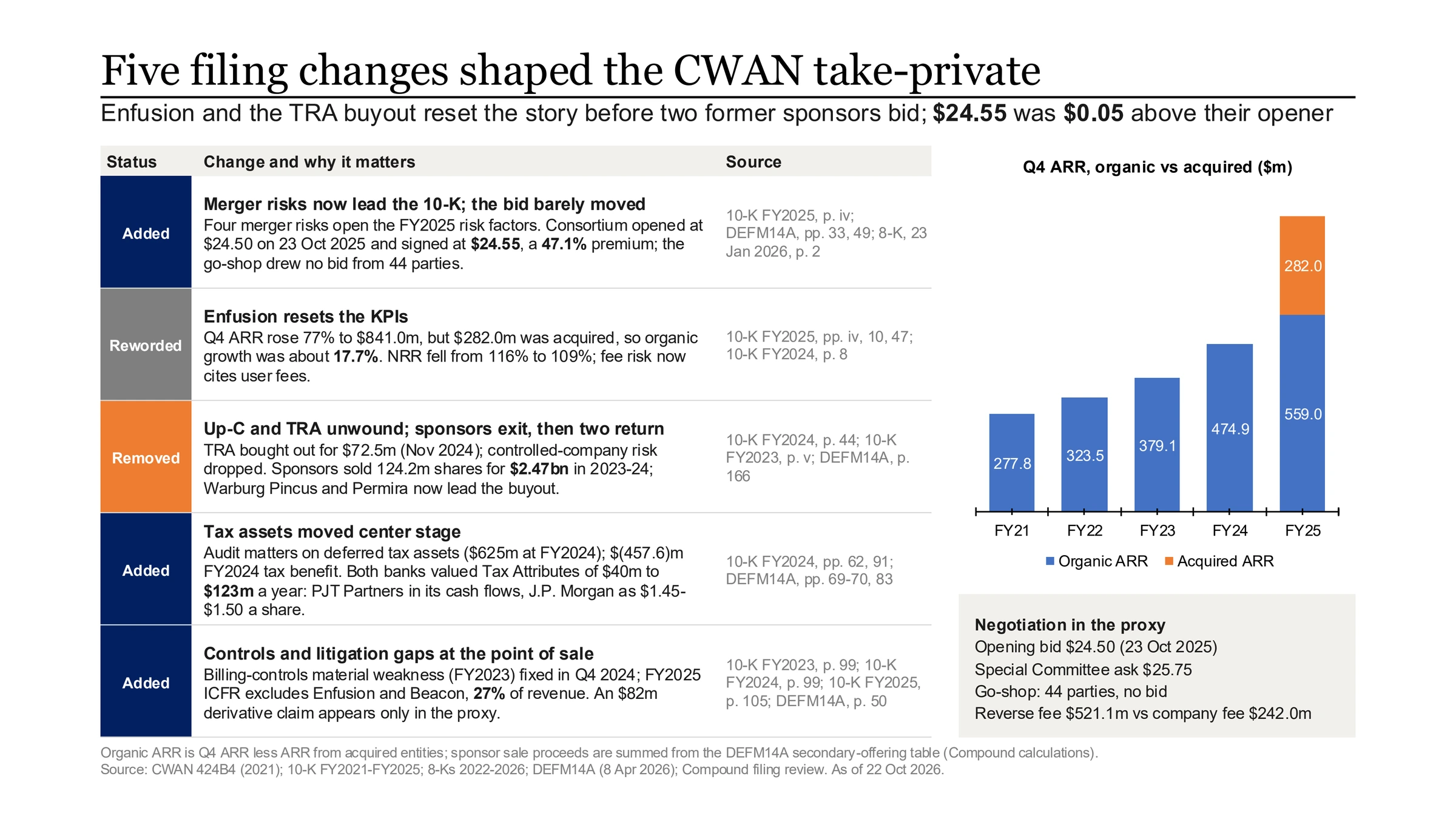
Read in order, the filings tell one story. The sponsors gave up control in 2024 and settled the TRA. The company bought Enfusion and Beacon in 2025, which lifted ARR and retention and took a quarter of revenue outside the tested controls. Then two of the sponsors bought the company at five cents above their own first bid, and the Tax Attributes the TRA no longer shared out came with it. None of this says the price was unfair, and both banks found it fair. It tells you which questions to bring to the valuation and the DCF: how much of the growth is acquired, what the Tax Attributes are worth, and how hard the price was tested. The earnings call analysis sets the same period against what management said in public.
SEC filing review workbook (Excel)Compound’s workbook from this run, free and without a form: Summary, 10-K Changes (38 rows across risk factors, KPIs, accounting policies, related parties, controls and legal proceedings), KPI Trend, 8-K Timeline and Take-Private, every row cited to its filing and printed page.Download · Free, no form One-page filing review slide (PowerPoint)Compound’s summary page for Clearwater: five filing changes, organic and acquired ARR, and the negotiation in the proxy on one slide.Download · Free, no form